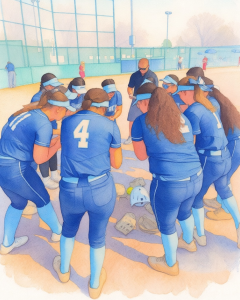
I recently spoke at Generation Thrive and The Golden State Foundation’s Coaches Unplugged to coaches across multiple sports and generations about how creating community within the team leads to a positive team culture.
For me, a positive team culture is when a coach values building relationships with their players and investing in their growth as people, over winning and losing. When players feel safe, seen, and supported by their coach, this creates emotional safety within the group. When players feel safe, they are more willing to take risks during practices and games, and they learn and grow as athletes and people.
During my presentation, I modeled how I build community and rapport with my players from the start of practice and at the start of the season. These are three coaching tools I share to create emotional safety within the team:
Coach Check-in
I begin every practice by checking in with my players to see how they are doing. I ask them how they are feeling and then have them answer using a 1–5 scale on their hand. I like using the “fist of five scale,” but another easy scale is thumbs up or thumbs down. Once I scan all of the self-reported answers, I use this data to help me make decisions about my practice plan.
Why this works – Have you ever asked a middle or high schooler how they are doing? Usually, their response is a one-word “good” or “fine,” which ends the conversation. By asking how they are feeling on a scale, I quietly gather way more information beyond “good” and “fine,” with no words. If my players report 4’s and 5’s, I know we can have a high-energy practice. If they report 2’s and 3’s, I adjust my practice plan to meet their needs. When students report a 1 or 2, I automatically plan to check in with them one-on-one during practice to offer support.
I encourage coaches to check in with their players because it only takes one caring adult to make a difference in a young person’s life. You might be the first caring adult of the day. Everyone wants to feel cared for, and a coach has a special opportunity to be that person.
Community Building Activity
After check-in, I intentionally weave in community building. Any drill, game, or activity can build community when it includes a teammate interaction, competition, skill practice, and fun. Teammate interaction can be as simple as talking to another teammate or as intricate as working together toward a common goal. Because being competitive is not innate for everyone, I think it is important to practice competition at practice. Competition can be against other teammates or against a clock to see how fast the team can do something. Skill practice can be sport-specific or interpersonal. Most importantly, when an activity is fun, that is where bonds and memories are made.
Why this works – The check-in shows that the coach cares, and the community-building activity warms up the group so players feel comfortable working together and trying new things. Doing this at the beginning of practice with a low-stakes activity builds players’ confidence in themselves and their teammates, making them more likely to take risks the rest of the practice.
Co-Create Team Agreements
I recommend this third step at the beginning of the season, but it is never too late to do it. To begin the co-creation process, I ask the team these four guiding questions and write down their answers as a brainstorm:
- How do we want to feel while together as a team?
- What do we want to see while together as a team?
- What do we want to hear while together as a team?
- And if we don’t feel, see, or hear those things, what do we do to get back to it?
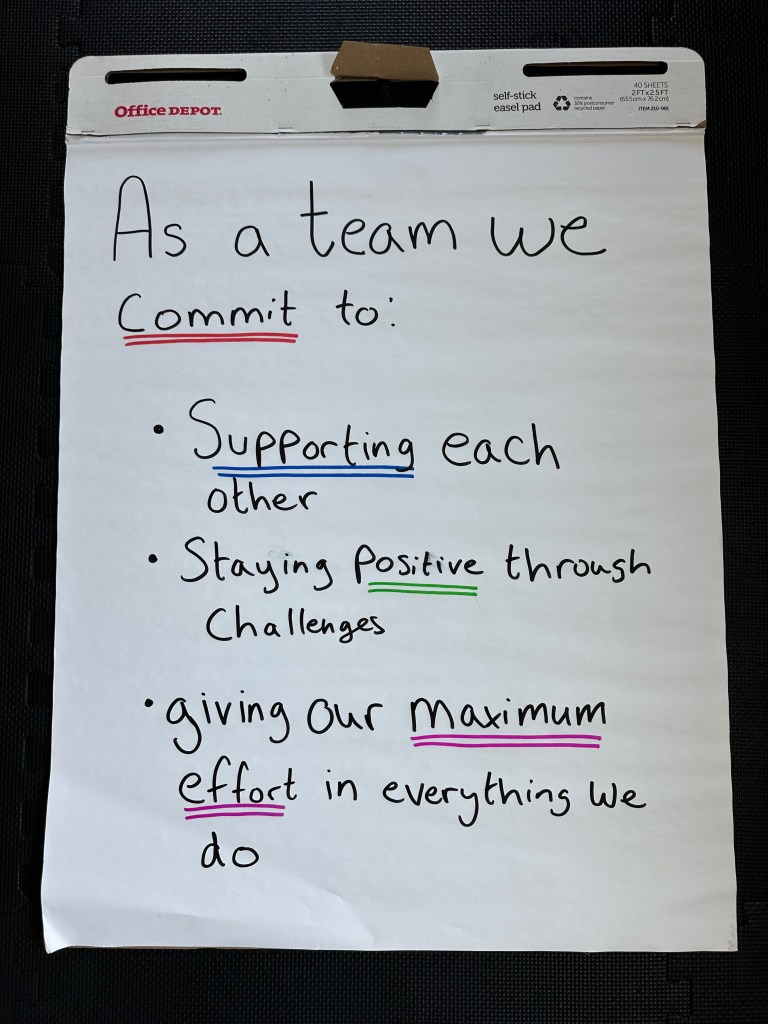
After the brainstorm, I help the team identify themes and prioritize the values the players list. With these words, we write a statement starting with “As a team, we commit to…” Here is a photo of a team agreement poster I made with one of my teams.
Why this works – I love this activity because the agreements are written in the players’ words. It is language they relate to and outlines the type of experience they want during the season. When players feel heard and have a say, they feel more invested in the team and empowered to live out the team’s commitment statement. It also allows players to hold each other accountable, which is much more powerful than when a coach dictates “the rules.” It shows that players’ voices and perspectives are valued on the team.
When coaches prioritize relationships, they create the foundation for community and a positive team culture. By starting each practice with a check-in, integrating community-building activities, and co-creating team agreements, players receive the support they need to thrive. These tools open the door for connections, trust, and a team environment where athletes feel empowered to take risks, grow, and enjoy the game. I encourage you to try these three tools with your team and see the difference relationships can make.