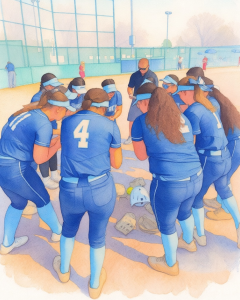
I am often asked if I would coach boys and girls differently. My answer is twofold. While the sport-specific skills I teach a youth girls’ or boys’ team would be the same, I would adjust the delivery and structure of practices to benefit the players the most.
For example, I’ve included a sample practice plan below for a youth basketball team that you can download and use with your own team. It follows my framework for creating successful practices: organized, engaging, well-paced, and fun. This practice plan would work for either a boys’ or girls’ youth team, but I would execute it a little differently depending on the team I was coaching.
Research from the Women’s Sports Foundation highlights the importance of social connection in girls’ sports experiences. Spending time with friends, feeling supported by coaches, and building relationships can all contribute to a positive experience in sports. As coaches, we can use this information to be intentional about how we structure practices and create opportunities for players to connect with one another. Competition is also an important part of sports, and the goal is to create an environment where connection, fun, and competition can coexist.
With this in mind, I would begin practices for a girls’ and boys’ team differently. For both teams, I would start with an opening circle to bring everyone together and signal the start of team time. From there, I would adjust the warm-up to meet the needs of the group.
For a girls’ team, I would give players five to seven minutes of warm-ups, such as stretching in lines or a circle and running a lap or two, and let them talk. This is their time to connect with teammates they may not have seen in a few days or catch up with friends after sitting quietly at a desk all day at school. At the beginning of the season, I might even pair up players and give them a prompt or question to discuss before letting the conversation go from there. I have found that when I allow social time at the beginning of practice, players are more focused throughout the rest of practice, and I have to redirect their side conversations much less.
For boys, after a brief opening circle, I would roll out the balls and let them play for the first five to seven minutes. I would allow this to be unstructured play, encouraging them to run around and get their energy out, or I might create a timed skills challenge before bringing them in for a brief stretch. This is an approach I have found useful in my coaching, particularly when players are eager to get moving and start playing.
The starts of these practices look different, but both serve the same purpose: they help prepare players to learn. As coaches, we want to think about what our athletes need to feel ready to engage, participate, and get the most out of practice.
Once the teams are ready to learn, it is important to consider how we communicate instructions and introduce new skills. Girls often appreciate detailed explanations, including an understanding of why they are learning a particular skill or doing a specific drill. When introducing something new to a girls’ team, I want coaches to be prepared to answer questions and explain the purpose behind the activity. There needs to be a reason for what we are doing at practice beyond “because I said so.” Leave time in your practice plan to go deeper, explain the connection between a skill and its purpose, and help players understand how to apply what they are learning in a game.
Boys often respond well to clear, concise communication and opportunities to learn through doing. When explaining a drill to a boys’ team, keep the instructions short and give players plenty of opportunities to experiment and learn through trial and error. One useful approach is to demonstrate or teach a skill, let players try it, and then bring the group together to ask, “What did you notice when you used the skill?” This encourages players to reflect on their experience and make connections without requiring a long lecture.
Feedback is another area where coaches can adjust their approach to support their athletes. Many girls benefit from positive reinforcement that builds confidence and helps them become more receptive to constructive feedback. It is especially important to separate self-worth from performance by affirming that you value players for their effort, preparation, and commitment, regardless of the outcome at practice or in a game. As coaches, we should recognize and reinforce the behaviors we want to see rather than focusing primarily on criticizing the behaviors we want to change.
Boys also benefit from positive coaching, but they may respond well to a more direct approach to feedback and adjustments. Keep instructions clear and specific, and give players opportunities to apply the feedback immediately. Regardless of the athlete, feedback should help them understand what they can do differently and encourage them to keep working toward improvement.
When planning practices for girls’ or boys’ teams, keep these approaches in mind. For girls, prioritize an environment of trust and collaboration, provide detailed instructions, and celebrate team success alongside individual achievements. For boys, incorporate high-energy activities and competitive drills, and use concise, clear feedback to support individual and team growth. These are starting points, not rules for every athlete. The sport is the same, and the development of athleticism and sport-specific skills remains the same, but the execution of the practice plan can look different depending on the players in front of you.
Ultimately, connection- and character-centered coaching is good coaching, regardless of the team’s identity. For me, connection and care always come first. This is particularly important when coaching girls, because I want them to know that I value them as people, not just as athletes. Some boys may be more immediately drawn to the sport and competition, with trust developing over time, but that does not change my approach. I want every athlete I coach to know that I care about them as a person first and an athlete second.
The goal is not to coach every girl or every boy the same way. It is to understand the athletes in front of you and make intentional decisions about how you plan, structure, and execute your practices. A well-organized practice gives you the framework, but it is how you deliver it that helps your athletes feel connected, stay engaged, and continue to grow.
Resources: