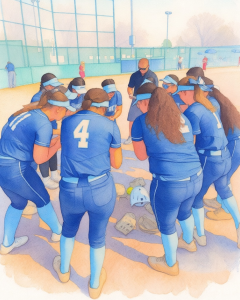
I recently met with the San Bruno 8U softball team for a team-building session focused on one important theme: being a good teammate and learning how to support one another.
This group of girls has been playing together for a while, and they are incredibly talented. That’s exactly why this conversation mattered. Building strong teammate habits now will set them up for success, not just this season, but throughout their entire playing careers.
Starting with Connection
To kick things off, I wanted the players to feel what it’s like to be supported by others.
We started with a game of Rock, Paper, Scissors Championship, a fun, high-energy way to get everyone moving, competing, and connecting.
Here’s how it worked:
- Everyone started as an individual competitor.
- Players found a partner, introduced themselves, and played a quick round of rock-paper-scissors.
- The winner advanced, and the “loser” became their cheerleader.
- Cheerleaders followed their “champion,” cheering them on in the next round.
- This continued until the final two champions faced off, each with a huge group of teammates cheering behind them.
To make it even more fun, we used our whole bodies:
- Rock = curl into a tiny ball
- Paper = jump out wide with arms and legs spread
- Scissors = arms straight out, clapping hands
This made the game more interactive and hilarious, especially when entire groups became “rock” or “scissors” together.
The Power of Being Cheered For
After the game, we reflected.
“What did it feel like to have people cheering for you?” I asked.
“It felt good!” one player said.
“It was fun cheering for other people,” another added.
Then I asked, “Did anyone lose right away and become a cheerleader?”
A few hands went up.
“How did that feel?”
“I was disappointed at first,” one player shared, “but after cheering for someone else, I forgot about it.”
That moment said everything.
Cheering for others doesn’t just lift them up, it can lift us up too.
What Is a Teammate?
From there, we moved into a discussion.
“What is a teammate?”
The girls shared:
- “Someone you play on a team with.”
- “A friend.”
- “Someone who cheers for you.”
We talked about how teammates don’t always have to be best friends, but they do need to be kind, supportive, and respectful.
Then I shared this definition:
A teammate is someone on your team who helps you, cheers for you, and works together with you so everyone can have fun and do their best.
A good teammate cheers on both the good days and the tough days, and is happy for others because it helps the whole team.
Reflection: Learning From Experience

Next, the players completed a short reflection activity:
- Draw or write about a time you were a great teammate.
- Draw or write about a time a teammate helped you.
Every player could think of a moment. Even at a young age, they understood what it feels like to lift someone up, and to be lifted up.
The Most Important Question
The final question was the most powerful:
How do you want your teammates to support you when you’re having a tough day?
During our group share, a clear theme emerged:
Every single player wanted positive words.
Some said:
- “Say ‘you’ll get it next time.’”
- “Give me a high five.”
- “Tell me it’s okay.”
- A few even said, “Give me a hug.”
The biggest realization?
Everyone is trying their best, even when they make mistakes. And when they do make mistakes, they want to be met with kindness and compassion.
My hope is that in that moment, they truly heard each other, and made a commitment to show up for one another in those ways.
More Than Just Softball
Being a good teammate is a skill. It’s something they are learning not just to have a great season, but to carry with them far beyond the field.
I’m excited to see how far this group can go.