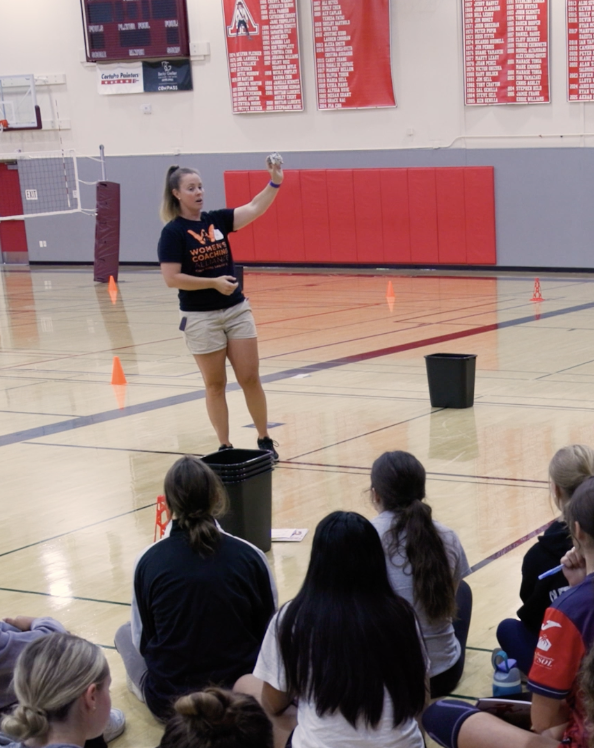
At a recent WCA Leadership Academy, I decided to teach a nonsensical sport to our coaches as a way to model best coaching practices. That’s how Trashketball was born.
At past Academies, I focused on teaching coaches sport-specific skills in the games they were preparing to coach. The coaches often said playing the sport was the highlight of the Academy, but I noticed many of them disengaged during the skills sessions. It made sense once I reflected. Our WCA coaches already know their sports inside and out. When I walked them through the basics of kicking a soccer ball or shooting a basketball, they went through the motions without much thought. What they didn’t realize was that I wasn’t trying to teach them the skills; I was modeling how first-time players experience learning, responding to coaching cues, and managing the energy of practice. Of course, they didn’t connect with that because they weren’t beginners. They were skilled athletes who had already mastered the game.
I wanted the coaches to experience what their players feel when they try a sport for the very first time. To make that happen, I needed to create a game no one had ever played so they could experience best-practice coaching with fresh eyes.

Trashketball uses two trashcans and a crumpled-up newspaper as the “trashball.” The game works a lot like Ultimate Frisbee. Players can’t run with the trashball or catch it. They can only advance the ball by passing to teammates with an open palm. The object is to move the trashball down the court and score by spiking it into the opposing team’s trashcan. Each successful spike counts as one point, and the team with the most points at the end wins. Trashketball is meant to feel a little ridiculous, after all, you’re playing with trash. That silliness is intentional, reminding coaches that youth sports should be fun, lighthearted, and not always serious.
I introduce the coaches to the two basic skills: passing and scoring. I use the cue “palm” to demonstrate hitting the trashball underhand with an open palm to a partner. As I hit the ball, I say “palm” aloud. I do the same thing to teach spiking, an overhand downward motion to hit the ball into the trashcan to score, saying “spike” as I demonstrate. After modeling both skills, I send the coaches off with their own trashball in pairs to practice while saying the cues aloud.
As soon as I hear them using the cues and see them getting the hang of it, I call the coaches in and divide them into teams. They start playing, and it looks more like trash flying everywhere than an actual sport. No one is entirely sure what to do, but they keep trying to pass and spike. When they look at me with unsure glances, I smile and cheer them on.
This moment mirrors exactly what first-time players, and first-time coaches, experience. Players often feel uncertain or look for guidance, and it’s up to the coach to monitor how the team is doing, encourage them to keep going, and decide when to pause and add more instruction.
After a few minutes of trashballs flying in all directions and very little scoring, I pull the group together to debrief. This is where the gold of the Trashketball lesson really shines.
“How did it feel to play Trashketball?” I ask.
“It was chaos!” one coach says.
“It was hard,” adds another.
“I wasn’t sure what to do,” a third admits.
“This is how your first practice may feel,” I tell them. “It’s unlikely you’ll have a team full of amazing 8-year-old athletes. For many of your players, it will be their first time trying the sport, and they’ll need clear direction. Did any of you notice what I did when you looked to me for help?”
A few blank stares follow.
“Anytime one of you looked at me with an unsure glance, I stood calmly and encouraged you,” I explained. “Even though it felt busy and chaotic, I stayed calm and confident so that all of you could stay calm and confident. Your team will mirror your energy.”
Then I ask, “What did work for you when playing the game?”
“When we said the cues, it reminded us of the skills to work on,” one coach responds.
“Yes, cueing!” I say. “Cues are short, clear phrases coaches use to describe the skill. What were our cues?”
“Spike!” they all shout.
“What else?”
“Palm!”
“Exactly.”
From here, I ask the coaches to think of three sport-specific skills from the sport they will coach that season and come up with their own cues. “Make the cues short, direct, and fun,” I advise. “You’re coaching kids, and they’ll remember better if the words are playful. For example, one soccer coach came up with the cue ‘hoppy’, like a bunny, for teaching dribbling.”
I love this lesson on cueing because it makes the cues authentic to the coaches’ own voices and experiences. Before we introduced Trashketball at the Academy, I gave them cues to use, but they didn’t stick, because they were my words, not theirs.
Every time we play Trashketball at a Leadership Academy, I discover new benefits. By putting coaches in the position of learning a game they’ve never played, they not only practice teaching with patience and clarity, but also reconnect with what it feels like to be a beginner. That perspective shift is invaluable. It helps them approach their own young athletes with empathy, creativity, and a sense of fun.